Quick Answer
Every tick mark on an inch ruler gets slightly shorter each time an inch is cut in half: longest lines mark whole inches, the next height marks 1/2 inch, then 1/4, 1/8, 1/16, and the shortest hairline ticks on precision rulers mark 1/32 inch.
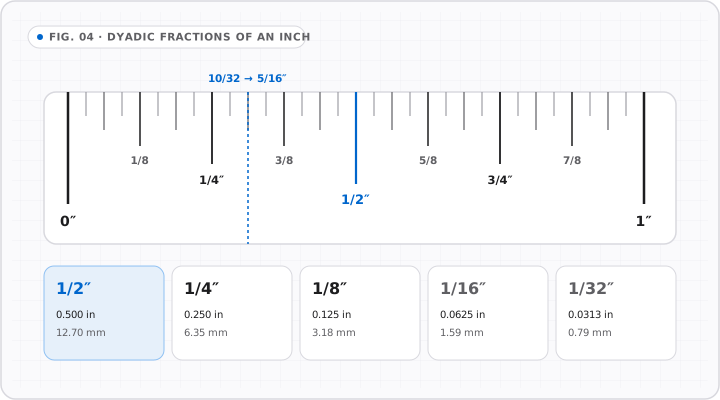
Every vertical line inside an inch has a deliberate height. Once you stop counting tiny lines one by one and instead read tick height first, reading 5/8", 11/16", or 23/32" takes less than a second.
You can practice live right alongside this guide by opening the interactive Inch Ruler and dragging its measurement guide across the ticks.
The Five Tick Heights Inside an Inch
Each step halves the previous spacing and steps down one level in line height:
| Subdivision Level | Ticks per Inch | Reduced Odd Positions | Decimal (in) | Exact Millimeters |
|---|---|---|---|---|
| Whole inch (tallest) | 1 | 0", 1", 2" |
1.0000” | 25.40 mm |
| Half inch (2nd tallest) | 2 | 1/2" |
0.5000” | 12.70 mm |
| Quarter inch (3rd) | 4 | 1/4", 3/4" |
0.2500” / 0.7500” | 6.35 / 19.05 mm |
| Eighth inch (4th) | 8 | 1/8", 3/8", 5/8", 7/8" |
0.1250” increments | 3.175 mm step |
| Sixteenth inch (5th) | 16 | 1/16", 3/16", … 15/16" |
0.0625” increments | 1.588 mm step |
| Thirty-second (machinist) | 32 | 1/32", 3/32", … 31/32" |
0.03125” increments | 0.794 mm step |
Notice the simple parity rule: every odd numerator belongs to its exact tick height. An unreduced numerator like 6/16 never lands on the shortest 1/16 tick—because 6/16 reduces to 3/8, it always lands on a taller 1/8 tick.
How to Identify 1 Inch Visually
People searching “how to identify 1 inch” without a tape measure often overestimate or underestimate it:
- Exact definition: Since the 1959 international yard and pound agreement adopted by the US, UK, Canada, and Australia,
1 inch = 25.4 mm(2.54 cm) exact. - US reference: A US Quarter Dollar is
24.26 mm(0.955"), just1.14 mmshy of a full inch. - UK / CA / AU reference: A UK £1 coin (
23.43 mmpoint-to-point) is just under 1 inch, while a Canadian Toonie (28.0 mm) is1.10".
For quick visual inspection on your monitor, switch to the calibrated Actual Size Online Ruler or open the dedicated 12-Inch Online Ruler.
Converting Between 1/16, 1/8, and 1/32 Quickly
In woodworking, sewing, and plumbing across the US, UK, and Canada, you will often move between 1/8, 1/16, and 1/32 drawings:
- Count to the nearest anchor tick (
1/4,1/2, or3/4). - Double the denominator to move one tick shorter: Halfway between
1/2"(8/16") and5/8"(10/16") is9/16". - Need finer tolerances? Divide a
1/16"space visually in half to read1/32"(~0.79 mm), or switch to millimeters on our MM Ruler where1 mmsits conveniently between1/32"(0.79 mm) and1/16"(1.59 mm).
Real-World Examples
- Bolt or pipe outside diameter: Measuring
7sixteenth-width steps from zero stops on the taller eighth-inch tick past3/8"? Wait:6/16 = 3/8", so one short step past3/8"is7/16"(11.11 mm). - Envelope or card margin: Measuring
3short ticks past3"lands on3 3/16"(80.96 mm). - Cabinet gap: One short tick short of
1/2"(8/16" - 1/16") is7/16", while one short tick past1/2"is9/16".
For printable templates and millimeter-to-fraction lookup tables, bookmark our MM to Inches Fraction Conversion Chart.
Interactive Tools on OnlineRulerPlus
Try It in the Calibrated Workspace
Questions & Answers
Frequently Asked Questions
How do you identify 1 inch on a ruler?
+
One inch is the distance between two consecutive tallest numbered lines on the imperial edge (for example, from 0 to 1 or from 3 to 4). On an accurately calibrated screen or physical ruler, 1 inch equals exactly 25.4 millimeters (2.54 cm)—slightly wider than a US quarter (24.26 mm).
What is the smallest line on a standard 12-inch ruler?
+
On everyday school, office, and DIY tape measures, the smallest line represents 1/16 of an inch (0.0625 in, or about 1.59 mm). Machinist rules and specialty engineering rulers sometimes subdivide further into 1/32 or 1/64 inch.
Why do inch rulers use fractions instead of 10ths like centimeters?
+
Traditional imperial carpentry and fabrication evolved around repeated halving—cutting a board, sheet, or span in two gives 1/2, 1/4, 1/8, and 1/16 naturally without needing a decimal scale. Decimal inch rulers (1/10 inch) do exist for technical drafting and CNC work.
Standards & Verified Sources
- NIST Handbook 44 — Appendix C: General Tables of Units of Measurement — Defines the international inch as exactly 2.54 centimeters (25.4 mm).
- OnlineRulerPlus Inch Ruler Tool — Interactive calibrated 1/16 inch screen scale.