Quick Answer
Divide millimeters by 25.4 to get exact decimal inches (for example, 10 mm ÷ 25.4 = 0.3937 in). Multiply that decimal by 16 or 32 and round to the nearest whole number to find the closest 1/16 or 1/32 inch tick on a ruler.
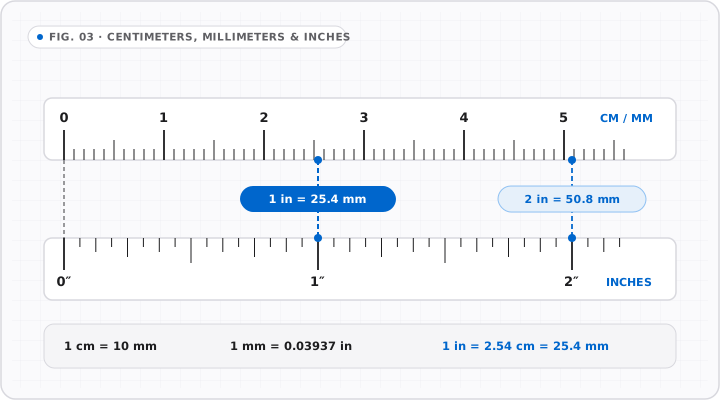
Whether you are matching a metric bolt to an imperial drill bit, reading 3D printing tolerances, or sizing watch straps, converting millimeters (mm) to fractions of an inch trips up nearly everyone because 25.4 does not divide cleanly by 16.
Use the lookup tables below—or read millimeters directly with our calibrated MM Online Ruler and compare against our Inch Ruler.
Exact Conversion Formula
- Millimeters to Decimal Inches:
inches = mm ÷ 25.4 - Millimeters to Nearest
1/16":sixteenths = round(mm ÷ 1.5875) - Millimeters to Nearest
1/32":thirty_seconds = round(mm ÷ 0.79375)
Quick Reference Table: 1 mm to 50 mm
| Millimeters | Exact Decimal (in) | Nearest 1/16” | Nearest 1/32” | Error to Nearest 1/32” |
|---|---|---|---|---|
1 mm |
0.0394" |
1/16" (loose) |
1/32" (0.79 mm) |
+0.21 mm |
2 mm |
0.0787" |
1/16" |
3/32" (2.38 mm) |
-0.38 mm |
3 mm |
0.1181" |
1/8" |
1/8" (3.18 mm) |
-0.18 mm |
4 mm |
0.1575" |
3/16" |
5/32" (3.97 mm) |
+0.03 mm (near exact) |
5 mm |
0.1969" |
3/16" |
3/16" (4.76 mm) |
+0.24 mm |
6 mm |
0.2362" |
1/4" |
1/4" (6.35 mm) |
-0.35 mm |
8 mm |
0.3150" |
5/16" |
5/16" (7.94 mm) |
+0.06 mm (near exact) |
10 mm |
0.3937" |
3/8" |
13/32" (10.32 mm) |
-0.32 mm |
12 mm |
0.4724" |
1/2" |
15/32" (11.91 mm) |
+0.09 mm |
13 mm |
0.5118" |
1/2" |
1/2" (12.70 mm) |
+0.30 mm |
16 mm |
0.6299" |
5/8" |
5/8" (15.88 mm) |
+0.13 mm |
19 mm |
0.7480" |
3/4" |
3/4" (19.05 mm) |
-0.05 mm (near exact) |
20 mm |
0.7874" |
13/16" |
25/32" (19.84 mm) |
+0.16 mm |
25 mm |
0.9843" |
1" |
1" (25.40 mm) |
-0.40 mm |
30 mm |
1.1811" |
1 3/16" |
1 3/16" (30.16 mm) |
-0.16 mm |
40 mm |
1.5748" |
1 9/16" |
1 9/16" (39.69 mm) |
+0.31 mm |
50 mm |
1.9685" |
2" |
1 31/32" (50.01 mm) |
-0.01 mm (near exact) |
Five Golden Metric-to-Inch Pairs Worth Memorizing
If you frequently work across US/imperial and UK/metric specifications, these five pairs match within 0.13 mm or better:
4 mm ≈ 5/32"(3.97 mm)8 mm ≈ 5/16"(7.94 mm)16 mm ≈ 5/8"(15.88 mm)19 mm ≈ 3/4"(19.05 mm— classic wrench crossover)50 mm ≈ 1 31/32"(50.01 mm— virtually exact at 5 cm)
Need whole-centimeter lookups above 5 cm, including luggage and waist conversions? Read our CM to Inches on a Ruler Guide or measure directly on MM Ruler.
Interactive Tools on OnlineRulerPlus
Try It in the Calibrated Workspace
Questions & Answers
Frequently Asked Questions
What is 10 mm in inches on a ruler?
+
10 mm equals 0.3937 inches—just slightly longer than 3/8 inch (0.375 in, or 9.525 mm) by less than half a millimeter (0.475 mm), and noticeably shorter than 7/16 inch (11.11 mm).
How do I convert millimeters to 1/16 inch fractions quickly?
+
Divide millimeters by 1.5875 (since 1/16 inch = 1.5875 mm) and round to the nearest integer over 16. Reduce even numerators—so 8/16 becomes 1/2 inch and 6/16 becomes 3/8 inch.
When is a fraction close enough vs. needing an exact metric tool?
+
For trim carpentry, envelopes, or fabric, rounding to the nearest 1/32 inch (error <= 0.4 mm) usually fits fine. Never force-fit imperial wrenches or machine bolts onto metric fasteners except true cross-over sizes where tolerance allows—for instance, 19 mm (0.748 in) is within 0.05 mm of 3/4 inch (19.05 mm).
Standards & Verified Sources
- NIST — Guide for the Use of the International System of Units (SI) — Exact definition: 1 in = 25.4 mm; 1 mm = 1/25.4 in.
- OnlineRulerPlus Millimeter Ruler — Calibrated 1 mm tick scale with precision cursor readouts.