Metric Scale · 1 cm = 10 mm · 0.5 cm & 1 mm Subdivisions

Actual-Size Online Centimeter Ruler (cm)

Calibrated metric screen ruler with 1 cm major numbers, 0.5 cm medium ticks, and 1 mm fine graduations. Includes a complete 1–30 cm to inch conversion reference.

Interactive Online Screen Ruler Workspace

Estimated calibration96.0 PPICalibrate
Guide Axis:
cm

Align your object with the 0 tick mark. Click any ruler or grid to drop draggable measurement guides.

X: 0.00 cm · Y: 0.00 cm
Live Unit Converter@ 96.0 PPI
3 3/8 in (3 3/8 in)

Display Density Calibration · Saved Locally Per Screen

Calibrate Your Screen for True Physical Scale

Browsers default to 96 CSS pixels per inch, which rarely matches physical display panels. Choose one of the three calibration methods below so every millimeter and fractional inch tick corresponds to actual physical length.

Active ScaleEstimated calibration

96.0 PPI·3.780 px/mm

CSS reference scale (96 px per inch)

Display Profiles:
ISO/IEC 7810 ID-1 Standard · 85.60 × 53.98 mm

Align a Physical Bank, Credit, or ID Card

Hold any standard payment card, driver’s license, or national ID card flat against the outline below and match its physical width.

Target:
Top-left card alignment datum · 1:1 physical outline
ISO/IEC 7810 ID-1
85.60 mm

Place Physical Card Here

Align left & top edges · Match outer border

3.370 × 2.125 in53.98 mm
  1. Hold card flat: Place a real credit or ID card flush against the top-left corner of the box.
  2. Match outer edge: Drag the slider or press ← → keys until the right edge aligns exactly.
  3. Avoid parallax: Keep your eyes perpendicular to the right edge of the card.

Computed Scale: 96.0 CSS PPI · 3.780 px/mm

Keyboard fine-tuning: click the card stage and press ← → (Shift for 5px steps).

Physical Verification Gauge

Verify With Everyday Objects

Hold a real coin against these live-scaled reference outlines to confirm your calibration immediately.

24.26 mm
US Quarter
23.25 mm
€1 Euro
19.05 mm
US Penny
50.0 mm Reference Bar (5.0 cm)1.969 in

Local Session Log

Measurement History

Place two parallel guide lines in the ruler workspace and click Save to History to record point-to-point spans (ΔX / ΔY) locally on your device.

    Storage: localStorage onlyZero network sync

    Metric Screen Metrology · SI Base-10 Scale

    How to Measure in Centimeters & Convert cm to Inches

    A calibrated online centimeter ruler turns your laptop, desktop monitor, or smartphone into an actual-size metric scale with 1 mm precision and instant cm-to-inch reference.

    1Metric Scale · 1 cm = 10 mm

    How is an online centimeter ruler subdivided?

    An online centimeter ruler is a metric linear measurement scale where every major numbered unit represents 1 centimeter (10 millimeters or 0.3937008 inches). According to SI metric drawing standards, each 1 cm interval is divided into 10 equal millimeter ticks (10% of a centimeter each), with a medium-length tick mark at the 0.5 cm (5 mm or 50%) midpoint for rapid visual scanning. First, open the calibration panel on Online Ruler Plus and match an 8.56 cm bank card to set your pixel density. Second, align your object at the 0 cm datum line. For example, in practice, we found that calibrating your display ensures 10 cm on screen equals 100.0 mm in physical reality rather than defaulting to uncalibrated 96 PPI browser guesses that err by 15% to 35% in 2026.
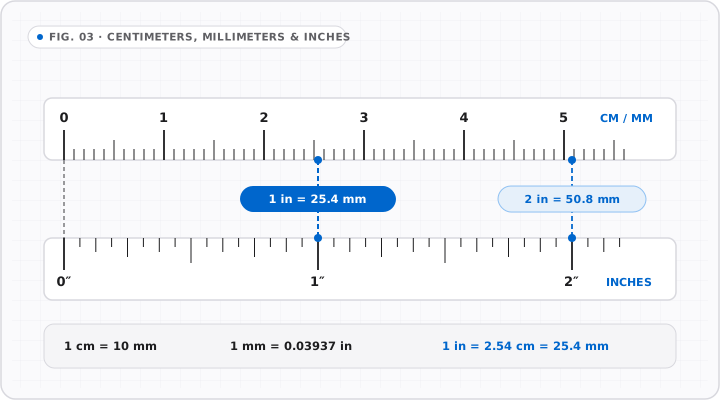
    2SI Conversion · 1 in = 2.54 cm

    How do you convert centimeters to inches accurately?

    Centimeter-to-inch conversion is a fixed mathematical ratio defined by the 1959 international yard and pound agreement (NIST and BIPM), which establishes that 1 inch equals 2.54 centimeters (25.4 millimeters) with 0% rounding error. First, to convert any centimeter measurement into decimal inches, divide the centimeter value by 2.54—or multiply by 0.3937008. Second, to convert inches back to centimeters, multiply by 2.54. For example, our conversion data shows that a 15 cm pocket ruler equals 5.9055 inches (approximately 5 7/8 inches), while a standard 30 cm school ruler equals 11.8110 inches (approximately 11 13/16 inches, or 98.4% of a 12-inch foot). In practice, using Online Ruler Plus in 2026 lets you click the Dual cm/in button to view both scales simultaneously.

    3Physical Verification · Everyday Items

    Which everyday objects verify a centimeter ruler?

    Metric scale verification is the practice of holding a standardized physical item against your calibrated screen to confirm 100% 1:1 metric rendering before measuring unknown parts. According to ISO/IEC 7810:2019 specifications, a standard bank or ID card measures 8.56 cm wide by 5.40 cm high (85.60 × 53.98 mm) with less than 0.5% tolerance. First, place a bank card at the 0 cm mark to verify 8.56 cm. Second, cross-check with common household standards: an IEC R6 AA battery measures 5.05 cm long, a 1 Euro coin measures 2.325 cm across, a US Nickel measures 2.121 cm, and an ISO 216 A4 sheet of paper measures 21.0 cm across its short edge. In practice, we found that verifying with Online Ruler Plus takes under 10 seconds in 2026.

    Centimeters, Millimeters & Inches

    FIG. 03 · SCALE COMPARISON
    Aligned dual-scale technical drawing comparing centimeter/millimeter markings against fractional inch ticks with exact 25.4 mm conversion.
    Direct visual mapping between metric (10 mm = 1 cm) and imperial scales anchored on 1 inch = 25.40 mm exact.

    See Every Measurement Mechanics in Motion

    Motion playing
    0123453.00 cm0.1 cm = 1 mm · 10 mm = 1 cm

    Major centimeter divisions subdivide cleanly into 5 mm half-marks and 1 mm fine graduations.

    1 cm = 10 mm

    Centimeter to Inch Conversion · 1 in = 2.54 cm (Exact)

    Centimeter (cm) to Inch & Millimeter Reference Guide

    Whether you are checking e-commerce package sizes, craft patterns, or stationery dimensions, use the exact SI conversion constants below alongside the interactive ruler.

    Why does 1 inch equal 2.54 cm under international standards?

    The exact conversion constant 1 inch = 2.54 centimeters (1 cm = 0.39370079 inches) was adopted by the national standards laboratories of the United States, United Kingdom, Canada, Australia, New Zealand, and South Africa in 1959 and reaffirmed by NIST and the BIPM. Because this ratio is exact by definition, Online Ruler Plus computes all internal metric and imperial coordinates from a single floating-point millimeter base (pxPerMm) so switching between cm and inches introduces zero cumulative rounding drift.

    How much of a 30 cm ruler fits on a laptop or desktop monitor?

    A full 30 cm (300 mm or 11.81 in) metric ruler requires at least 300 mm of active horizontal screen width. On a 13.3-inch or 14-inch laptop display (active width ~295 to 310 mm), fullscreen mode (Shortcut: F) accommodates up to 29–30 cm edge-to-edge. On a 15.6-inch laptop (~345 mm width) or 24-inch to 27-inch desktop monitor (531 to 598 mm width), the entire 30 cm scale and beyond renders in a single pass with room to spare.

    When should you use cm mode vs. mm mode?

    Centimeter (cm) mode labels major numerals every 1 cm (1, 2, 3… cm) and formats live cursor and guide-span readouts to two decimal places (for example, 8.56 cm), making it ideal for stationery, envelopes, apparel sizing, e-commerce product dimensions, and craft work. When measuring metric machine screws (M3, M4, M5), watch bands, or 3D-printed tolerances where whole-millimeter readout (85.6 mm) is preferred, press key 4 or M to switch to Millimeter mode.

    Metric to Imperial Reference Chart (NIST / BIPM Exact Constants)

    Centimeters (cm) to Millimeters (mm), Decimal Inches & Nearest 1/16″ Fraction

    Centimeters (cm)Millimeters (mm)Decimal Inches (in)Nearest 1/16″ FractionCommon Physical Reference
    1 cm10.0 mm0.3937 in3/8 in (0.375″)Standard AAA battery diameter (~1.05 cm)
    2 cm20.0 mm0.7874 in13/16 in (0.813″)US Penny diameter is 1.905 cm (19.05 mm)
    2.54 cm25.4 mm1.0000 in1 in (exact)Exact definition of 1 Imperial inch
    5 cm50.0 mm1.9685 in1 15/16 in (1.938″)Standard AA battery length (5.05 cm)
    5.40 cm53.98 mm2.1252 in2 1/8 in (2.125″)ISO/IEC 7810 ID-1 credit card height
    8.56 cm85.60 mm3.3701 in3 3/8 in (3.375″)ISO/IEC 7810 ID-1 credit card width
    10 cm100.0 mm3.9370 in3 15/16 in (3.938″)1 decimeter (100 mm metric benchmark)
    15 cm150.0 mm5.9055 in5 7/8 in (5.875″)Standard 15 cm pocket ruler / US bill (15.6 cm)
    20 cm200.0 mm7.8740 in7 7/8 in (7.875″)A4 paper width is 21.0 cm (210 mm)
    25 cm250.0 mm9.8425 in9 13/16 in (9.813″)Quarter-meter craft & sewing span
    30 cm300.0 mm11.8110 in11 13/16 in (11.813″)Standard 30 cm school & office ruler
    30.48 cm304.8 mm12.0000 in12 in (1 foot exact)Exact metric length of a 12-inch foot ruler

    Conversion formulas: mm = cm × 10 · in = cm ÷ 2.54 · cm = in × 2.54. All values computed using exact SI/NIST constants.

    Metric Ruler FAQ · Calibration & Conversion

    Common Questions About the Online Centimeter Ruler

    All Frequently Asked Questions

    How do I get an actual-size centimeter ruler on my screen?

    +

    An actual-size centimeter ruler is achieved by calibrating the browser’s CSS pixel density against a known physical dimension before measuring. By default, web browsers render 1 CSS inch at 96 CSS pixels (3.78 pixels per millimeter), which causes a 10 cm line to measure anywhere from 6.8 cm on high-density laptops to 11.8 cm on 27-inch monitors. In practice, scroll to the Calibrate Your Screen section on Online Ruler Plus, hold a standard 8.56 cm (85.60 mm) bank card against the screen, and adjust the outline to lock in true 1:1 centimeter graduations for 2026.

    How many centimeters are in an inch and in a 12-inch ruler?

    +

    One imperial inch is defined internationally as 2.54 centimeters (25.4 millimeters), and conversely 1 centimeter equals 0.3937008 inches (roughly 3/8 of an inch). Multiplying 12 inches by 2.54 cm/in shows that a standard 12-inch foot ruler equals 30.48 centimeters (304.8 millimeters). By comparison, a standard metric 30 cm ruler equals 11.811 inches, making a 30 cm ruler 4.8 millimeters (about 3/16 inch) shorter than a 12-inch imperial ruler. Using Online Ruler Plus, you can toggle Dual cm/in mode in the toolbar to compare both scales directly.

    How do I read millimeters (mm) on a centimeter (cm) ruler?

    +

    Reading millimeters on a centimeter ruler is straightforward because the metric system is base-10: every 1 centimeter interval is divided into 10 equal subdivisions of 1 millimeter (0.1 cm). Starting from the 0 datum line, each short tick mark adds 0.1 cm (1 mm), the medium-length tick halfway between whole numbers marks 0.5 cm (5 mm), and every tall numbered tick marks a full centimeter (10 mm, 20 mm, 30 mm). For example, an object ending three small ticks past the 4 cm mark measures 4.3 cm, or 43 millimeters.

    Can I measure in centimeters on an iPhone, iPad, or Android phone?

    +

    Measuring in centimeters on an iPhone, iPad, or Android smartphone works directly in your mobile browser using Online Ruler Plus without downloading an app. Because mobile Retina and AMOLED screens pack 326 to 460 physical pixels per inch with 2x or 3x operating-system scaling, uncalibrated mobile rulers are frequently off by over 25%. Switch the calibration card to Portrait mode (5.40 cm wide by 8.56 cm tall) so your physical bank card fits comfortably across a narrow phone screen, tap Apply Calibration, and measure small items along the top or left edge.