Quick Answer
The most accurate way to measure without a physical ruler is to hold the object against an ISO/IEC 7810 ID-1 payment card (85.60 mm × 53.98 mm, or 3.37 in × 2.125 in), a flat sheet of Letter or A4 paper, or use a calibrated online ruler on your screen.
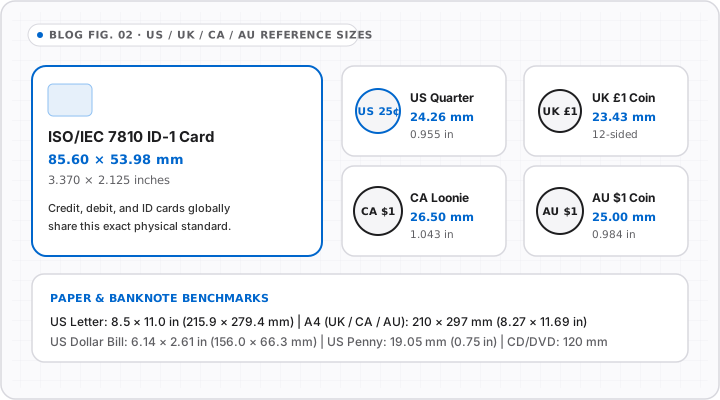
When you need a quick measurement for an online return form, a replacement screw, or a luggage tag and no physical ruler is nearby, the items already in your wallet or desk drawer follow strict international manufacturing tolerances.
Even better, pairing one standardized reference object with a calibrated online ruler or Photo Ruler turns a rough guess into a repeatable measurement.
Tier 1 Accuracy: Plastic Cards & Office Paper
Rigid plastic cards and factory-cut reams of office paper resist stretching and stay dead flat:
| Reference Object | Region | Exact Metric Size | Exact Imperial Size | Best For |
|---|---|---|---|---|
| ISO/IEC 7810 ID-1 Card (Credit/Debit/ID) | Global | 85.60 × 53.98 mm |
3.370 × 2.125 in |
Screen calibration & small objects |
| US Letter Paper | US / Canada | 215.9 × 279.4 mm |
8.5 × 11.0 in |
Boxes, luggage, medium parts |
| ISO A4 Paper | UK / Australia / Global | 210 × 297 mm |
8.27 × 11.69 in |
~30 cm stand-in, crafts, envelopes |
| US Dollar Bill (all denominations) | United States | 156.0 × 66.3 mm |
6.14 × 2.61 in |
Quick ~6-inch check |
| Canadian Banknote (polymer) | Canada | 152.4 × 69.85 mm |
6.00 × 2.75 in |
Exact 6-inch reference |
Fold trick for A4 & Letter paper: Fold a sheet of US Letter widthwise (8.5") in half to get 4.25" (108 mm), and in half again for 2.125" (54 mm). Fold an A4 sheet’s short 210 mm edge in half for 105 mm (10.5 cm), and in half again for 52.5 mm.
Tier 2 Accuracy: Minted Coins (US, UK, Canada, Australia)
Minted coins are struck from hard alloys and retain consistent diameters over decades of circulation:
| Coin | Country | Diameter (mm) | Diameter (Inches) | Mental Approximation |
|---|---|---|---|---|
| US Penny (1¢) | USA | 19.05 mm |
0.750 in |
Exact 3/4 inch |
| US Quarter ($0.25) | USA | 24.26 mm |
0.955 in |
Just shy of 1 inch |
| UK 20p Coin | UK | 21.40 mm |
0.843 in |
Slightly over 2.1 cm |
| UK £1 Coin (12-sided) | UK | 23.43 mm |
0.922 in |
~2.34 cm (point-to-point) |
| Canadian Quarter ($0.25) | Canada | 23.88 mm |
0.940 in |
Just under 2.4 cm |
| Canadian Loonie ($1) | Canada | 26.50 mm |
1.043 in |
Just over 1 inch |
| Australian $1 Coin | Australia | 25.00 mm |
0.984 in |
Clean 2.5 cm reference |
| Australian 20¢ Coin | Australia | 28.65 mm |
1.128 in |
Nearly 2.9 cm |
Tier 3: Turning Any Phone Photo Into an Exact Measurement
Holding a screw against a coin only tells you “smaller than a quarter.” If you need an actual 18.5 mm or 11/16" reading:
- Lay a credit card (or any known coin from the table above) flat beside the item on a contrasting table.
- Snap a single photo straight down from directly above (about
30–40 cmaway to reduce lens distortion). - Open OnlineRulerPlus Photo Ruler, upload or paste (
Ctrl+V) the photo, click the two edges of the card (85.6 mm), then measure any part of the object in inches, cm, or mm.
Why Body Parts (Thumb, Hand Span) Fail for Precision
Rule-of-thumb approximations—like calling the tip of an adult thumb “1 inch” or a hand span “9 inches”—easily drift by 15% to 25% between adults. Reserve body approximations for rough furniture placement, and use an ID-1 card, coin, or calibrated Online Ruler whenever fit matters.
Interactive Tools on OnlineRulerPlus
Try It in the Calibrated Workspace
Questions & Answers
Frequently Asked Questions
What everyday object is closest to exactly 1 inch?
+
A US Quarter Dollar has a diameter of 24.26 mm (0.955 inches), making it about 1.1 mm shy of 1 inch (25.4 mm). The short 12-inch edge of US Letter paper is 8.5 inches, while the long edge of A4 paper is 297 mm (11.69 inches).
What is the single best reference item if I do not own a ruler?
+
Any standard bank, debit, credit, or driver's license card built to the ISO/IEC 7810 ID-1 specification is globally standardized at 85.60 mm × 53.98 mm (3.370 × 2.125 inches). Placing an object next to one lets you estimate visually or measure digitally via our Photo Ruler.
Can paper bills or banknotes be used to measure without a ruler?
+
Yes, though coins and plastic ID-1 cards stay flatter and wear less. Every current US Federal Reserve note measures 6.14 × 2.61 inches (156 × 66.3 mm). Polymer Canadian bills measure 152.4 × 69.85 mm (6.0 × 2.75 in), while UK and Australian notes vary in width by denomination.
Standards & Verified Sources
- U.S. Mint — Coin Specifications — Quarter diameter 24.26 mm (0.955 in); Penny 19.05 mm (0.750 in).
- The Royal Mint — Coin Designs and Specifications — UK 12-sided £1 coin 23.43 mm (point-to-point); 20p 21.4 mm.
- Royal Canadian Mint — Circulation Coins — Canadian $1 Loonie 26.5 mm; Quarter 23.88 mm.
- Royal Australian Mint — Circulating Coins — Australian $1 coin 25.00 mm; 20c coin 28.65 mm.